
Diocese of Borongan, SIPPAD call on Giporlos, Balangiga Councils to oppose new mining permit
By RAY P. GASPAY
July 25, 2026
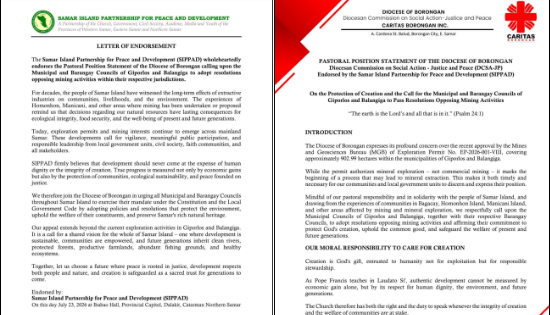
CATBALOGAN CITY, Samar – The Diocese of Borongan, through its Diocesan Commission on Social Action, Justice and Peace (DCSA-JP) and Caritas Borongan Inc., has formally called on the municipal and barangay councils of Giporlos and Balangiga to adopt resolutions opposing mining activities within their jurisdictions, following the recent approval of an exploration permit covering nearly 903 hectares in the two towns.
In a pastoral position statement endorsed by the Samar Island Partnership for Peace and Development (SIPPAD), Church leaders warned that Exploration Permit No. EP-2026-001-VIII – approved by the Mines and Geosciences Bureau (MGB) for approximately 902.99 hectares across Giporlos and Balangiga – marks the beginning of a process that could eventually lead to mineral extraction, despite currently authorizing only exploration.
"The earth is the Lord's and all that is in it," the statement quoted Psalm 24:1, emphasizing that creation is entrusted to humanity "not for exploitation but for responsible stewardship."
A Timely and Necessary Stand
The Diocese expressed "profound concern" over the permit, noting that while it does not authorize commercial mining, it opens the door to further development. Mindful of their pastoral responsibility and in solidarity with Samar Island communities, Church officials urged the Sangguniang Bayan of both municipalities and all Sangguniang Barangays to exercise their mandate under the Constitution and the Local Government Code by passing resolutions that protect God's creation, uphold the common good, and safeguard present and future generations.
The appeal draws heavily on the lived experiences of communities in Bagacay, Homonhon Island, Manicani Island, and other parts of Samar affected by mining and mineral exploration. The statement listed well-documented risks linked to such activities, including degradation of forests and watersheds; contamination of rivers and coastal waters; loss of productive agricultural and fishing areas; increased risks of erosion, flooding, and landslides; and social conflict within affected communities.
As one of the country's most typhoon-prone provinces, Eastern Samar must place a high value on protecting its natural ecosystems, the Diocese said, noting that these ecosystems "safeguard communities from disasters and sustain the livelihoods of its people."
Broad Coalition of Support
The statement was endorsed by SIPPAD, a partnership representing the Church, government, civil society, academe, media, and youth across Western Samar, Eastern Samar, and Northern Samar. In a separate letter of endorsement signed at Ibabao Hall in Catarman, Northern Samar, SIPPAD said the experiences of Homonhon, Manicani, and other mining-affected areas serve as a reminder "that decisions regarding our natural resources have lasting consequences for ecological integrity, food security, and the well-being of present and future generations."
SIPPAD firmly believes that development "should never come at the expense of human dignity or the integrity of creation," and that progress must be measured not only by economic gains but also by the protection of communities, ecological sustainability, and peace founded on justice.
The letter was endorsed by three bishops: Most Rev. Isabelo C. Abarquez, D.D. of Calbayog; Most Rev. Crispin B. Varquez, D.D. of Borongan; and Most Rev. Nolly Caminque Buco, D.D. of Catarman.
Moral Imperative and Call to Action
Citing Pope Franci' encyclical Laudato Si', the Diocese stressed that authentic development cannot be measured by economic gain alone, but by "its respect for human dignity, the environment, and future generations." The Church, it added, "has both the right and the duty to speak whenever the integrity of creation and the welfare of communities are at stake."
The Diocese also invoked the words of Pope Benedict XVI: "The environment is God's gift to everyone, and in our use of it we have a responsibility towards the poor, towards future generations, and towards humanity as a whole."
In its call to action, the Diocese invited local government leaders, civil society organizations, faith communities, farmers, fisherfolk, indigenous peoples, youth, and all people of goodwill to work together in pursuing "a model of development that respects human dignity, protects the environment, and promotes the common good."
The Diocese of Borongan, it concluded, "remains steadfast in promoting peace, justice, and responsible stewardship of our common home."
The pastoral statement and endorsement were both dated July 23, 2026.